
Over the last decade, schools invested billions in classroom devices such as laptops, tablets, phones — believing they would make learning more modern.
Instead, the data shows something very different.
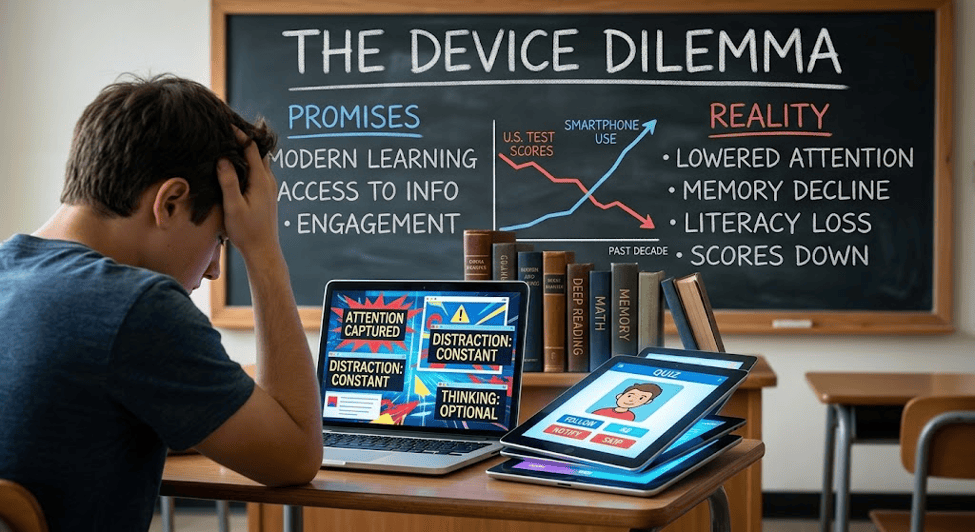
- A neuroscientist told the U.S. Senate that decades of putting screens in schools have weakened learning environments, lowering attention, memory, literacy, and numeracy.
- Maine’s statewide laptop program, one of the earliest, did not raise test scores over 15 years.
- PISA found that students who spent more time on digital devices during the school day performed worse than peers with limited device use. (Inference based on PISA declines and Senate testimony.)
And the most striking pattern:
- The decline in U.S. reading and math scores lines up almost perfectly with the explosion of smartphone use among teenagers.
We handed students devices engineered by the world’s smartest minds — not to educate them, but to capture their attention. Then we expected them to focus, think deeply, and learn complex material.
Thinking became optional. Distraction became constant. And learning paid the price.
If we want students to read, think, and solve problems at high levels, we must design schools that protect attention — not compete with billion‑dollar attention machines.
#Education # #EdTech #SchoolLeadership #EducationPolicies


Leave a comment